
Medicinal Mushrooms, Algae and
ALA – The Molecular Science Behind Heavy Metal Detoxification
We live in
an era of unprecedented technological progress, which, however, comes with a
hidden cost—systemic exposure to an invisible toxic burden. Heavy metals (lead,
mercury, cadmium, nickel and tin) and metalloids (such as arsenic) reach us
daily through fine particulate matter in the air, industrially contaminated
soil, urban water supply systems and seafood.
As
nutritionists and healthcare professionals, we know that true detoxification is
not a temporary juice diet, but a precisely managed biochemical process. In
this article, we will take an in-depth look at exactly how heavy metals damage
our cells and how the synergy between medicinal mushrooms, microalgae and
Alpha-Lipoic Acid (ALA) interrupts these processes at the molecular level.
Why Are Heavy Metals So Toxic? (Anatomy of the Damage)
Unlike
organic toxins, which the liver can break down and metabolise, heavy metals are
chemical elements—they cannot be destroyed. Once they enter the bloodstream,
they exert their effects through two particularly dangerous mechanisms:
Affinity for
sulfhydryl groups (-SH): Heavy metals literally “love” sulfur. They bind to the sulfur-containing
groups of our proteins and structural enzymes. When a metal, such as mercury,
binds to an enzyme, it alters its three-dimensional structure and inactivates
it. This disrupts vital cellular functions.
Ionic
mimicry: Due to
their similar atomic radius and electrical charge, toxic metals “disguise”
themselves as beneficial minerals. Lead mimics calcium, cadmium mimics zinc,
and arsenic mimics phosphate. The body is deceived by this disguise and allows
them to enter the cells, replacing essential nutrients with toxic substances.
Oxidative
stress and mitochondrial death: Accumulated metals block the respiratory chains in
the mitochondria—the cell’s powerhouses. This leads to the massive generation
of reactive oxygen species (ROS), which destroy cell membranes and damage DNA.
In order to
be eliminated, these metals must be physically captured, neutralised and
transported out of the body. Here is how this happens:
1. Microalgae: A Mechanism of Physical Adsorption and
Interruption of Recirculation
Detoxification
requires the intestinal tract to be secured first. When the liver filters the
toxic burden from the blood, it conjugates these substances and excretes them
into the intestines through the bile. Because of the physiological mechanism of
enterohepatic recirculation, the body attempts to reabsorb bile in the terminal
part of the small intestine. Along with it, heavy metals may also pass back
into the bloodstream, circulating in a closed loop for years.
Chlorella (Chlorella
pyrenoidosa) and Spirulina possess a unique mechanism for addressing this
problem:
Cell-wall
structure: Chlorella
has a thick, three-layered cell wall composed of cellulose and specific
polysaccharides, including sporopollenin. During technological processing for
use in supplements, this wall is “broken” or “weakened”. This keeps its
functional groups exposed and highly reactive.
Passive
adsorption: The surface
of these microalgae is rich in carboxyl, hydroxyl and phosphate chemical
groups, which carry a strong negative charge. Positively charged ions of lead
(Pb²⁺), mercury (Hg²⁺) and cadmium (Cd²⁺) are electrostatically attracted to
the surface of the algae. They bind tightly into insoluble complexes, acting
like a physical adhesive. This blocks their passage through the enterocytes—the
intestinal cells—and allows them to be eliminated directly through the faeces.
2. Medicinal Mushrooms: Specific Biosorption Through
Polysaccharide Matrices
In
mycotherapy, Chaga (Inonotus obliquus) and Maitake (Grifola frondosa)
are being intensively studied for their ability to biosorb heavy metals.
Polysaccharide–protein
complexes: The
cellular matrix of these mushrooms is composed of complex beta-glucans, chitin
and high levels of the pigment melanin, particularly in Chaga. These polymers
form a dense, three-dimensional network.
Chemical
capture: These
matrices contain nitrogen- and oxygen-donor atoms, including amino and amide
groups, which form so-called coordination bonds with heavy metals.
Chaga shows
an exceptional affinity for lead and cadmium. Under laboratory conditions, its
polysaccharides have been reported to bind and neutralise up to 89–95% of the
available metal ions.
Maitake has
a high content of sulfhydryl groups, which rapidly encapsulate mercury in the
gastrointestinal tract.
Hepatoprotection: While performing this intermediate
binding function, the mushrooms provide powerful antioxidants, such as
superoxide dismutase, which protect liver tissue from inflammation caused by
toxins circulating in the blood.
3. Alpha-Lipoic Acid (ALA): Intracellular Thiol
Chelation
While algae
and mushrooms primarily cleanse the intestinal lumen and extracellular space,
Alpha-Lipoic Acid (ALA) carries out deep cellular detoxification. It has
amphiphilic properties—it is both water- and fat-soluble—which allow it to pass
readily through the lipid bilayer of cell membranes and cross the blood–brain
barrier.
Conversion
into DHLA: Once inside
the cellular cytoplasm, ALA is rapidly reduced by enzymes to dihydrolipoic acid
(DHLA).
Direct
chelation—“sulfur pincers”: Unlike ALA, the DHLA molecule possesses two free, highly reactive
sulfur-containing thiol groups (-SH). These two groups act like molecular
“pincers”. They surround the heavy-metal ion—with the highest affinity for
organic and inorganic mercury, lead and arsenic—from both sides. A stable
cyclic complex, known as a chelate, is formed. It is biochemically inert and is
therefore no longer toxic to the body. This complex is readily soluble and can
be transported safely out of the cell towards the excretory organs.
Glutathione
regeneration: Because
metals rapidly deplete glutathione, DHLA donates its hydrogen atoms to
regenerate “used” glutathione, as well as vitamins C and E, maintaining the
cell’s antioxidant capacity at its maximum level.
4. Zinc: Ionic Antagonism and Metallothioneins
It is also
important to mention the fundamental role of zinc in this process through the
mechanism of competitive antagonism.
When the
body has sufficient bioavailable zinc, it competes with heavy metals—especially
cadmium and lead—for the same transport proteins and enzyme receptors. Zinc
occupies these binding sites first. In this way, it blocks the ability of toxic
metals to become incorporated into cellular structures and cause damage.
In addition,
zinc stimulates the synthesis of metallothioneins—specific proteins in the body
that are naturally programmed to capture and neutralise metals.
Why Is Three-Stage Synergy Essential?
Taking a
powerful intracellular mobilising agent such as ALA on its own carries risks.
It may draw mercury out of fatty tissues and the nervous system and into the
bloodstream. However, if the intestinal barrier is permeable and adsorbents
such as algae and mushrooms are absent, these metals may simply be reabsorbed
in the intestines and redistributed to another vital organ, such as the
kidneys.
A safe
formula requires synchronisation:
- ALA opens the cells and draws
metals out of deep tissues.
- Chaga and Maitake protect the
liver from oxidative stress and capture the circulating toxic burden.
- Chlorella and Spirulina
intercept everything in the intestines, interrupt the toxic cycle and
ensure its final elimination from the body.
- Zinc and B vitamins occupy receptor
sites and support the liver’s methylation pathways involved in processing
metalloids such as arsenic.
Important Advice When Choosing Supplements
Because both
algae and medicinal mushrooms are excellent natural magnets for metals, they
can easily become contaminated during their growth in the natural environment.
When designing therapeutic protocols, always choose products from reputable
laboratories that use raw materials from controlled cultivation and subject
them to rigorous testing to confirm the absence of heavy metals.
Only in this way can we be confident that their adsorption capacity remains fully available and ready to help purify the human body.
The Professional Solution for Cellular Detoxification
All the
molecular mechanisms described above—from interrupting enterohepatic
recirculation to deep intracellular thiol chelation—are brought together in a
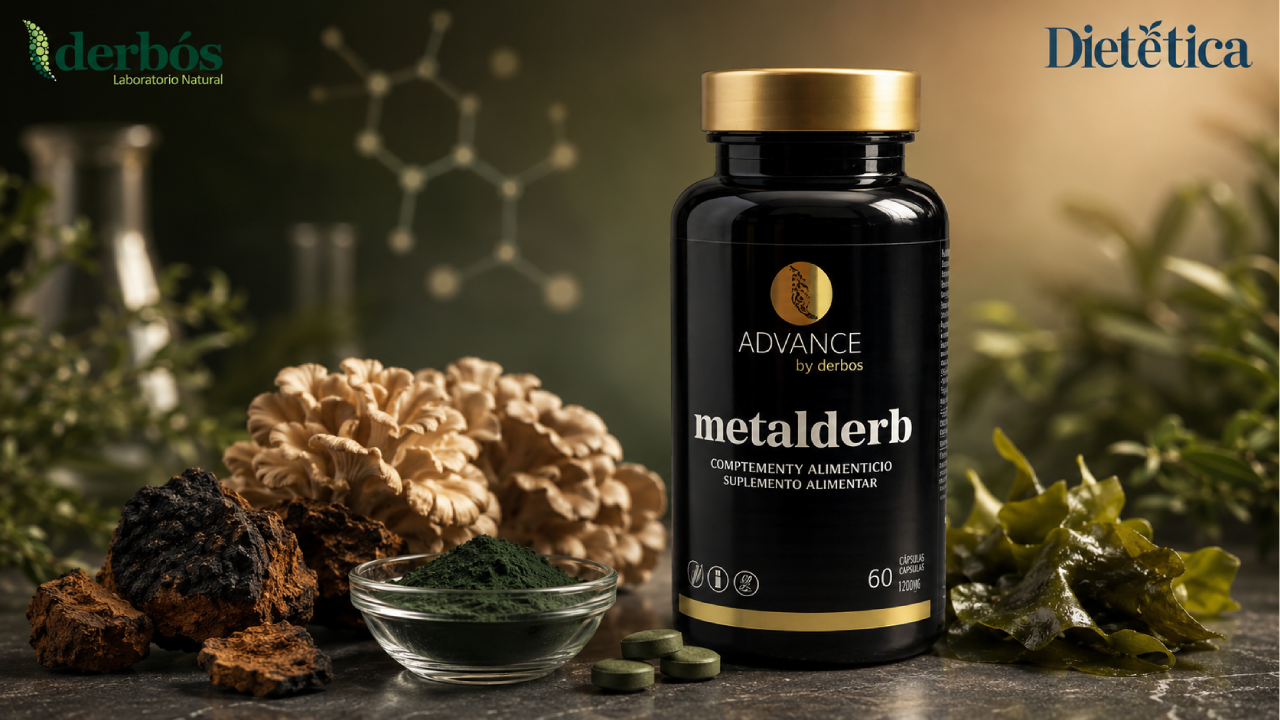
precise synergy in METALDERB, part of the ADVANCE range by Derbós (Laboratorio
Natural).
Instead of
relying on aggressive chemical intervention, METALDERB uses an intelligent,
multi-layered approach to gradual physiological detoxification. Its formula
combines precise therapeutic doses of:
- Broken-cell-wall Chlorella and
Spirulina to bind toxins in the intestinal tract.
- Highly purified Chaga and
Maitake extracts for biosorption and liver protection.
- Alpha-Lipoic Acid (ALA), NAC
and L-Methionine for deep cellular and nervous-system detoxification and
glutathione regeneration.
- Zinc and key B vitamins for
ionic antagonism and support of hepatic methylation.
All
ingredients in the product undergo rigorous laboratory purity testing and are
obtained from controlled cultivation. This ensures that their adsorption
capacity remains fully available, without the risk of introducing external
contaminants.
Learn more about the complete composition and mechanism of action of METALDERB in the catalogue at Dietetica.bg.
- Alpha-Lipoic Acid (ALA) & Thiol Chelation Mechanisms:
- Mahmoudi, M., et al. (2024). Alpha-lipoic acid, as an effective agent against toxic elements. Environmental Science and Pollution Research. Available at PubMed / NCBI.
- Ghibu, S., et al. (2023). Molecular and Therapeutic Insights of Alpha-Lipoic Acid as a Powerful Dithiol Antioxidant. Biomedicines. Available at PMC.
- Chlorella, Spirulina & Enterohepatic Recirculation Interruption:
- Zeraatkar, A. K., et al. (2025). The Efficiency of Chlorella in Heavy Metal Removal: Passive Adsorption vs. Intracellular Uptake. Sustainability. Available at MDPI.
- Mehrandish, R., et al. (2019). Heavy metals detoxification: A review of herbal compounds for chelation therapy in heavy metals toxicity. Journal of Herbmed Pharmacology. Available at ResearchGate.
- Medicinal Mushrooms (Chaga & Maitake) & Biosorption:
- Ahmad, A., et al. (2026). Biosorption of Heavy Metals as a New Alternative Method for Environmental and Cell Bioremediation: A Review. Egyptian Journal of Aquatic Biology and Fisheries. Available at EJABF Journal.
- Kapoor, A., & Viraraghavan, T. (2005). Heavy metals biosorption by mushrooms. Natural Product Radiance. Available at NOPR Repository.
- Nutritional Chelation & Endogenous Pathways:
- Sears, M. E. (2013). Chelation: Harnessing and Enhancing Heavy Metal Detoxification Pathways for Whole-Body Health. The Scientific World Journal. Available at PMC / NCBI.
Leave a Comment